publications
2025
- Under ReviewStrategic Nitrogen Recommendations for Potatoes: Soil- and Climate-Specific Insights from the Model-Based Identifying NEMO FrameworkMoreteza Mesbah, Kristen Murchison, Mariaelisa Polsinelli, and 2 more authorsAgricultural Science & Technology, 2025
@article{mesbahStrategicNitrogenRecommendations2025,
  title = {Strategic Nitrogen Recommendations for Potatoes: Soil- and Climate-Specific Insights from the Model-Based Identifying NEMO Framework},
  author = {Mesbah, Moreteza and Murchison, Kristen and Polsinelli, Mariaelisa and Jégo, Guillaume and Morissette, René},
  year = {2025},
  journal = {Agricultural Science & Technology},
  publisher = {American Chemical Society},
  selected = true
}
2024
- Proceedings
 Imbalanced Datasets and Crop Yield Prediction: Application of Preprocessing Techniques for Regression Tasks in AgricultureMariaelisa Polsinelli, Morteza Mesbah, Zhiming Qi, and 1 more authorIn 2024 ASABE Annual International Meeting, 2024
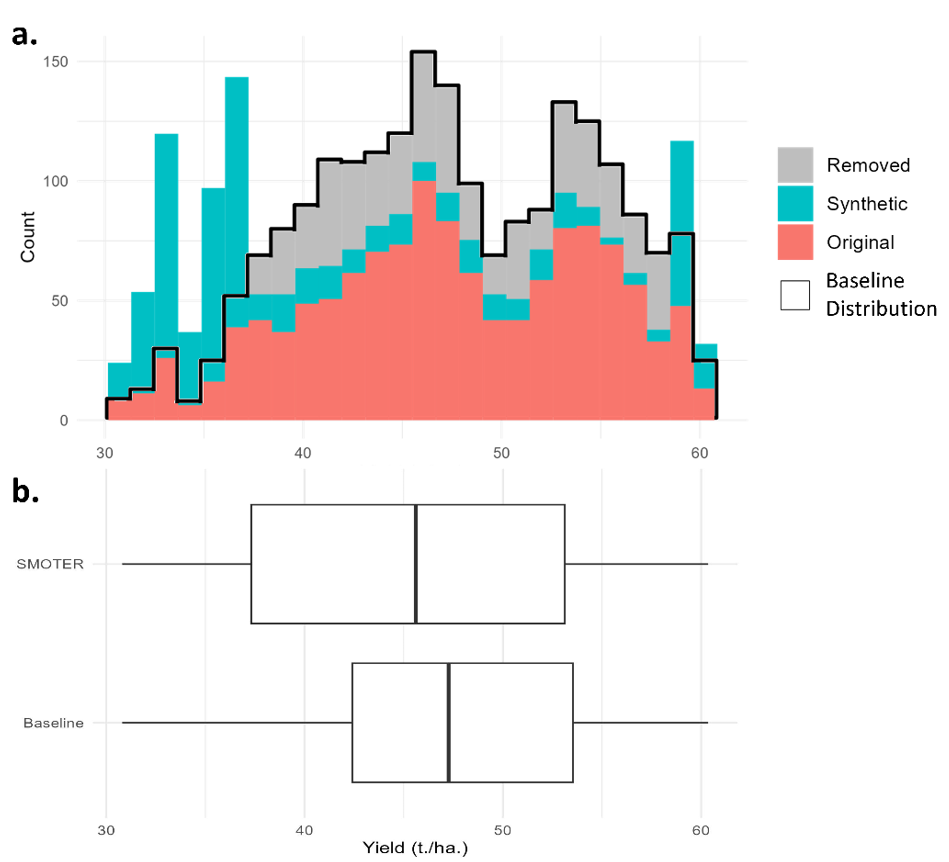
Machine learning (ML) is increasingly used in the agricultural sector to predict crop yields. The ability to produce short-term seasonal forecasting or future projections is highly important for creating climate change adaptation strategies. The escalation of extreme weather events such as drought due to climate change is a significant threat to crop yields. While ML algorithms like Random Forest (RF) have shown great performance on balanced datasets, the increase in weather extremes presents a challenge as historical data may lack instances of low yield years, leading to unbalanced datasets biased towards ‘normal’ or ‘well performing’ years. Three preprocessing techniques; random undersampling (US), random oversampling (OS), and the Synthetic Oversampling Technique for Regression (SMOTER) were applied to the training datasets of nine industrial farm field-years growing Russet Burbank using RF. Assessing the nine field-years overall, US improved the relative root mean square error (RRMSE) from the baseline the most reducing it from 16.7[PM(1.1]% to 14.1%. Individually, US was the winning technique for five of the nine fields, likely due to a reduction in overfitting. SMOTER provided the largest improvement in performance for Field 3b (drought year). The baseline RRMSE for this field was 36.8% (poor). The application of SMOTER to synthetically increase low yield data points and high GDD low precipitation values in the training dataset reduced the RRMSE to a satisfactory 26.3%. The results indicate that SMOTER, potentially in combination with other performance techniques, can be a viable option for improving the yield prediction of drought and extreme weather years.
@inproceedings{polsinelliImbalancedDatasetsCrop2024,
  title = {Imbalanced Datasets and Crop Yield Prediction: Application of Preprocessing Techniques for Regression Tasks in Agriculture},
  booktitle = {2024 ASABE Annual International Meeting},
  author = {Polsinelli, Mariaelisa and Mesbah, Morteza and Qi, Zhiming and Ramsay, Matt},
  year = {2024},
  pages = {1},
  publisher = {American Society of Agricultural and Biological Engineers},
  doi = {10.13031/aim.202400813},
  url = {https://elibrary.asabe.org/abstract.asp?aid=54797},
}